If you have ever bowed out a first aid course reasoning, "I hope I never need this," you are not the only one. The unpleasant reality is that many individuals do need it, and commonly. Out-of-hospital heart attack happens thousands of times every week across many countries, generally in homes, workplaces, or public rooms. The distinction between a disaster and a survival tale regularly boils down to one thing: whether somebody nearby remembers their CPR training and acts quickly.
The catch is that the majority of people take CPR training once, then let years slip by. Techniques alter, self-confidence fades, and when something takes place, that reluctance costs time. This is where a fast CPR refresher course gains its keep. With the appropriate layout, you can update your first aid and CPR skills while it takes to eat lunch, without investing a complete day in a classroom.
I have educated both full-day first aid courses and express CPR sessions tucked right into active work routines. The rate is not the trouble. Poor design is. A fast cpr refresher course can be exceptionally effective if it is snugly concentrated, hands-on, and matched to your actual risks in your home or at work.
Let us walk through what a truly helpful express cpr course appears like, exactly how to pick one, and cpr courses Joondalup exactly how to press real worth out of a single lunch break.
Why a fast CPR refresher deserves your hour
Whenever I ask groups why they are in a CPR or first aid training course, the responses cluster around compliance and commitment. "Work told me I needed to." "I require a first aid certificate for my work." Only a handful claim, "Since I am anxious I would certainly ice up if my kid or colleague broke down."
Yet that last concern is precisely what a fast CPR or express first aid course ought to deal with. Not simply ticking a box, however changing that freeze action with a practiced, nearly automated sequence.
Several points make a short refresher particularly beneficial:
You are topping up existing knowledge, not starting from zero. The essential abilities are currently in your memory, also if they really feel rustic. With assisted technique, they come back quickly.
You focus on what saves lives, not every unusual scenario. An excellent fast first aid course does not try to cover every minor injury. It hangs out on what will certainly eliminate someone in minutes if you do not act: heart attack, obstructed airway, severe bleeding.
You find out present guidelines, not what you vaguely remember from years back. CPR recommendations transform every 5 to 6 years as proof builds up. Compression depth, hand positioning, when to utilize an AED, when to utilize breaths - every one of this advances. A fast cpr course is a possibility to reset your mental script to existing standards.
For work environments, a short, targeted session is often the only sensible way to preserve a safe atmosphere without drawing team off the floor for a full day. I have actually run 45 to 60 minute fast first aid training obstructs in hospitals, building lawns, offices, and child care setups, all constructed around that reality.
What "fast CPR refresher" really means
Different service providers utilize different language: fast cpr, express cpr training, fast first aid courses, express first aid training, mixed or on-line refreshers. Labels can be complicated, so it helps to strip them down to core formats.
Typically, a fast cpr correspondence course falls under one of 3 models:
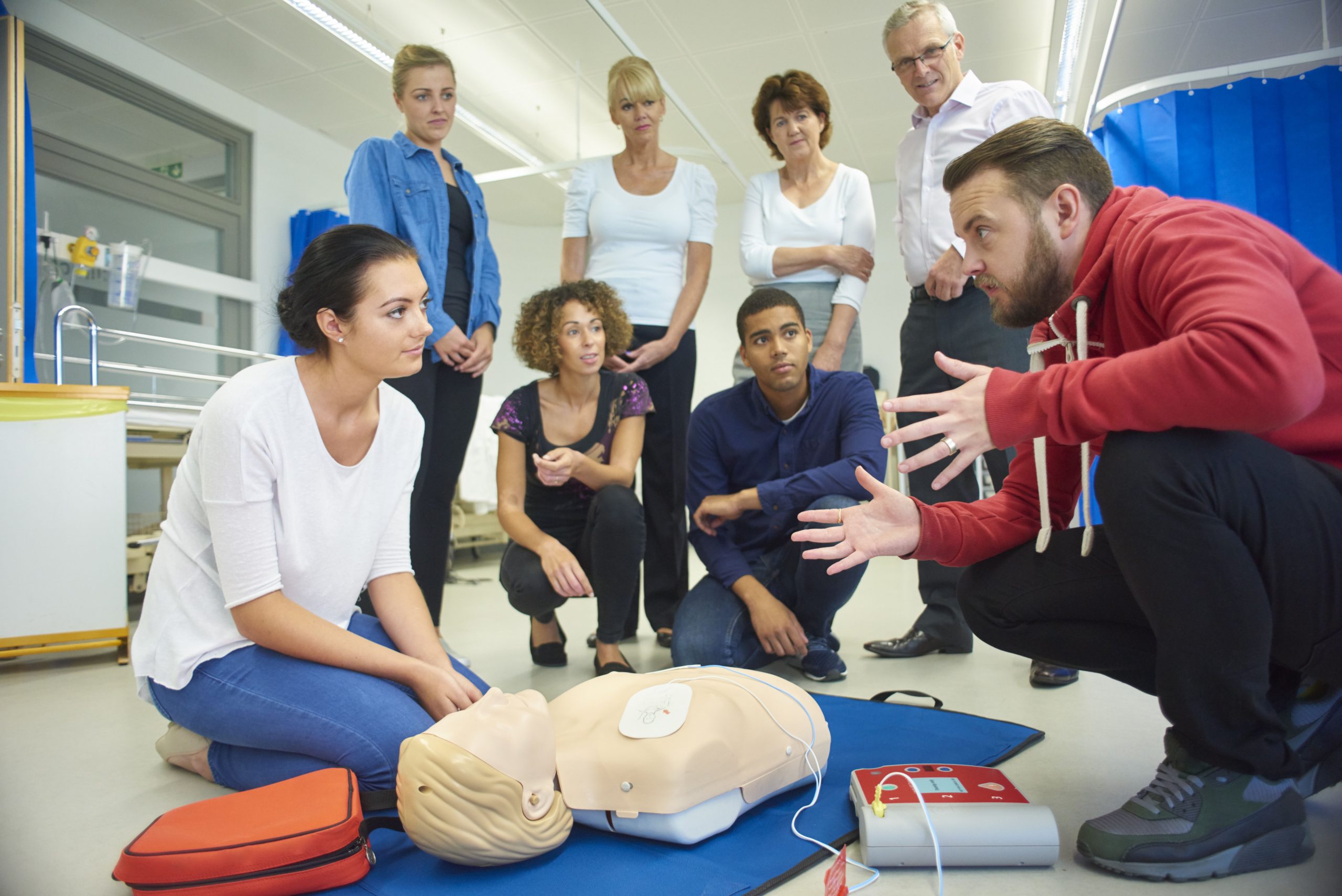
Short in-person session, generally 45 to 90 mins, focused nearly completely on hands-on skills. In these, you could spend 10 to 15 mins revising the theory of cardiac arrest, after that the remainder of the time on manikins and technique circumstances. This is frequently what people photo as a "lunch-break" course.
Blended express first aid course, where theory is done online in advance, then you participate in a much shorter in-person session to show CPR and first aid skills. This is an usual layout for fast certification, and in my experience it functions well for active specialists who can handle the self-paced online element in the evenings.
Fully on-line refresher, sometimes marketed as "fast CPR courses" or "express cpr courses". These can be helpful for expertise refresh, especially if your office permits online-only proof. However, they have a major limitation: you can not practice compressions, breaths, or AED pad placement on a real manikin, so your muscular tissue memory does not benefit.
If you currently hold a first aid certificate, pay attention to whether the supplier clearly provides a first aid and cpr course as a refresher, not simply a first qualification. Refresher-oriented classes often tend to move much faster, presume previous exposure, and spend more mins on useful job instead of long lectures.
For childcare employees and instructors, "express child care first aid course" or "express childcare first aid training" usually shows an educational program straightened with your regulator or licensing body, however provided in pressed time blocks. The secret is verifying that the reduced style still meets the main needs for paediatric cpr and first aid.
Skills you can in fact refresh over a lunch break
In a 60 min fast cpr correspondence course, you will not master every phrase in the fap first aid handbooks. That is great. The objective is not breadth, it is sharpness where it matters.
Here is what I regularly see functioning well in a limited time frame:
Recognising cardiac arrest quickly and decisively High high quality chest compressions on a grown-up manikin Safe and positive use of an AED Basic airway management and rescue breaths, if your function requires them An easy emergency situation action plan so you know what to do first, 2nd, and thirdThose 5 factors audio evident theoretically. Under stress and anxiety, though, individuals miss them, reverse them, or delay at action one. A great trainer will certainly build short, practical situations that compel you to identify a non-responsive casualty, phone call for aid, and get straight onto the chest.
When I instruct express cpr training, I expect small information: where your shoulders rest over the casualty, whether you are permitting full recoil, if you are losing time between compressions and AED shocks. We do small changes instantly. Because feeling, a fast cpr refresher course really feels much less like a lecture and even more like individual coaching.
If the course is marketed as first aid and cpr training classes as opposed to pure CPR, you may additionally touch on choking therapy, serious bleeding control, and the recuperation position. The method is not to rush through lots of strategies. I would rather see somebody entrust solid CPR, AED, and choking abilities than a hazy memory of 15 various injuries.
Making 60 minutes matter: a sample structure
To offer you a feeling of what an efficient express cpr course can look like, below is a harsh framework I have actually used for office-based teams with previous first aid training:
|Sector|Time (approx.)|Focus|| ------------------------------|----------------|----------------------------------------------------|| Rapid concept revitalize|10 mins|What heart attack is, chain of survival, signals|| Grown-up CPR method|20 mins|Compresssions, breaths if included, comments|| AED method|10 mins|Pad placement, safety, following triggers|| Choking and healing setting|10 minutes|Grown-up choking, safe lateral position|| Scenario rotation + Q&| 10 mins|Brief drills, inquiries, worries|
With a little team and an engaged teacher, that solitary hour supplies more actual retention than a long lecture-heavy day. The trick is small class sizes or enough manikins. If one teacher is juggling 20 individuals with three manikins, every person spends half the class watching, not doing.
When you look for a fast first aid course near me or fast cpr courses, this is one of the inquiries worth asking: "The amount of people per manikin?" For a brief, intensive session, a ratio of 2 or 3 per manikin is perfect, 4 is convenient, anything greater starts to threaten the advantage of an express format.
What has transformed given that your last CPR course
One of the initial inquiries I ask in refreshers is, "When did you last do CPR training?" It prevails to hear "7 or eight years back" or "At some time before covid." A lot can transform in that time.
Some of the shifts that often shock individuals:
More emphasis on high quality compressions. Deepness and rate still matter, but there is more powerful concentrate on permitting full breast recoil and minimising disruptions. Several modern manikins give real-time comments on deepness and rate, which is a powerful eye-opener. You know exactly how quickly you wander too shallow or too slow.
Hands-only CPR is commonly accepted for inexperienced spectators. Many first aid and cpr courses now instruct that if you are not positive with rescue breaths, you should begin company, fast compressions and maintain going up until aid or an AED shows up. That clarity eliminates a lot of hesitation in genuine emergencies.
AEDs are currently assumed, not optional. When I started instructing, AEDs were uncommon in public areas. Now you find them in going shopping centres, offices, institutions, fitness centers, aircraft. Fast first aid courses appropriately spend time debunking the tool. The reality is an AED is made to direct a layman: turn it on, follow the voice prompts, do not overthink it.
Guidance on breathing checks has evolved. Older training sometimes encouraged long "look, listen, and feel" checks that delayed action. Existing technique in numerous systems favours quick evaluation: if the person is unresponsive and not breathing generally, deal with as cardiac arrest and begin CPR. That word "generally" matters, due to the fact that agonal gasps can misguide an untrained rescuer.
For those in specific sectors, especially express childcare first aid courses, paediatric resuscitation details could have changed as well: compression proportions in some consolidated CPR, suggestions on breaths versus compressions in particular age, and focus on protecting against respiratory tract occlusion.
A fast cpr correspondence course must not sink you in every detail of guideline updates. Instead, it ought to appear the adjustments that actually affect what your hands and decisions carry out in the first minutes.
First help and CPR: do you revitalize both, or just CPR?
Many people come searching for "fast cpr" or "express cpr course" because they believe they only require breast compressions. Sometimes that is true. In an office with clear emergency response, protection personnel and on-site medics may handle broader first aid, and your function is to begin CPR and fetch the AED.

In other situations, especially in smaller services or childcare, first aid and CPR are almost indivisible. You may be the only person express childcare first aid Hobart available to recognise anaphylaxis, control bleeding, call emergency situation services, and begin CPR if points deteriorate.

When finding in between:
- a pure CPR training session, an incorporated first aid and cpr course, or a wider express first aid course,
Think concerning your practical duties. Parents, sports trainers, educators, and childcare personnel generally take advantage of a small yet combined first aid and CPR training course. You do not require a marathon first aid course, but you do need to be able to deal with choking, bronchial asthma strikes, seizures, severe allergic reaction, and that rare yet devastating paediatric cardiac arrest.
For hectic workplace staff whose major danger is a coworker falling down, a fast cpr correspondence course with AED method is usually sufficient, provided a minimum of a few staff likewise hold a much more detailed first aid certificate.
One useful design I such as is a mixed method across a work environment: a core group completes complete first aid training every couple of years, while the bigger personnel rotate via fast first aid courses or express cpr training each year. That constructs a culture where many individuals are comfortable beginning standard life assistance, and a smaller sized number can deal with much more complex situations.
Choosing a fast course that still constructs real competence
The market around CPR courses and first aid training is crowded. When you search online for a fast first aid course near me or express CPR and first aid training certifications cpr courses, you will certainly see whatever from reputable nationwide service providers to confidential sites offering instantaneous certificates.
A few uncomplicated checks aid arrange the helpful from the questionable:
Accreditation and recognition
Make sure the provider issues a first aid certificate or CPR certificate that your employer, industry regulator, or licensing body identifies. For instance, several childcare guidelines define that an express childcare first aid course must be straightened with certain nationwide standards.Hands-on method time
Ask clearly how much of the fast first aid or express cpr course is invested doing compressions and making use of an AED, rather than seeing slides. If hands-on time is much less than fifty percent of the session, be cautious.Instructor background
A trainer with real-world emergency experience, such as paramedics, nurses, or long-serving first aid fitness instructors, normally brings functional nuance. They will certainly discuss what in fact takes place in untidy atmospheres, not just book diagrams.Class dimension and equipment
Small teams and adequate manikins matter extra in a compressed layout than in a long course. If 20 people are sharing two manikins in a 60 min session, your "fast first aid training" becomes a waiting game.Clear scope
Credible suppliers are honest about what the fast certification covers. If a one hour online video clip promises to replace complete first aid and cpr courses for all expert functions, be skeptical.I remind employers that a certificate is not magic. What you desire is a person that can push set in the appropriate location at the correct time, send somebody for the AED, and provide the emergency situation call taker clear details. Choose carriers whose course layout pushes people towards that outcome.
Preparing yourself prior to the lunch-break course
The best fast first aid courses start before you step into the area. With a little prep work, you can stroll in ready to maximize every minute.
At minimum, do this the day prior to:
Look up the emergency number made use of in your area and how it deals with mobile phones, internal work phones, and building protection. If your structure has a certain process or expansion number, understand it. This appears evident, yet in actual emergencies, people commonly screw up with phone systems.
Find out where the nearest AEDs really sit in your work environment, health club, or school. Keep in mind not just the location, but the path. In training, individuals commonly uncover they have no idea where the gadget is, even though they stroll past it weekly.
Mentally practice an easy three-step pattern: examine responsiveness and breathing, call for assistance, start compressions. Visualising those activities prior to training primes your brain. When you then do the fast cpr refresher course, the physical technique locks into a manuscript you already recognise.
If your express first aid course consists of an on-line theory component, take it seriously rather than hurrying via. Those brief components liberate the in-person time for the abilities that genuinely need coaching.
Wear comfortable garments to your session. You will be stooping, leaning, and relocating. I have seen individuals in limited formal clothing stopped their own technique time simply since it was literally awkward to get on the floor.
After the course: maintaining CPR abilities to life between refreshers
One of the biggest misconceptions about first aid and cpr courses is that the certificate amazingly keeps your skills fresh for its complete legitimacy duration. It does not. Abilities fade in months, not years, specifically if you never use them.
The great news is you do not require a full course every few weeks. Five minute refresher courses, done sometimes, go a long way.
Here are functional means to maintain your skills active between official refreshers:
Use reputable brief video clips from identified first aid organisations a few times a year. View a heart attack scenario, after that shut your eyes and speak on your own with what you would do, in order. You are rehearsing decisions and sequencing.
If your work environment has manikins available, talk with your safety officer concerning establishing brief "CPR decrease in" sessions. Even 10 minutes of compressions every few months keeps your hands and position tuned.
In team meetings, do a fast safety and security round: where are the closest AEDs, who has existing first aid training, who feels comfortable starting CPR. These small conversations build a culture where first aid is visible, not hidden in a thick manual.
Parents and carers can adapt children's games to strengthen basic concepts. For instance, older youngsters can learn to identify "unresponsive, not breathing generally" as a sign to call an adult and the emergency situation number. That is casual express first aid training, however it drives home the idea that doing something is better than doing nothing.
For professionals in controlled functions, pay attention to your certificate expiry, specifically for childcare first aid and CPR. Do not leave renewal to the last week. Fast first aid courses and express child care first aid courses are prominent, and the very best suppliers fill up early.
When a fast course is not the ideal answer
Despite my interest for brief refresher courses, there are times when a fast cpr or express first aid course is the wrong tool.
If you have never done first aid training previously, a pure online, thirty minutes video course is not likely to prepare you genuine emergency situations. You require the feeling of compressions, the physical awkwardness of rolling someone into the recuperation position, the sensory shock of the AED pads and prompts. That discovering takes more time.
If your office has complex dangers, such as chemicals, machinery, remote areas, or risky populaces, you possibly need a fuller first aid course with scenario-based technique tailored to those risks. The fast styles are better as supplements, not replacements.
If your CPR knowledge is incredibly outdated, say you last skilled 10 or more years earlier, take into consideration a preliminary complete course once more, then make use of fast cpr refresher courses in following years. The first session back usually needs more time to rebuild foundations.
There is a balance to strike. You want training that values your time, but not training so slim that it produces a false sense of competence.
Bringing it into your genuine life
The point of any first aid and cpr course is not the piece of paper. It is those few mins between collapse and expert aid showing up, when the only point that stands between the casualty and death is an onlooker's determination and capacity to act.
A well made fast cpr refresher course, or a thoughtfully provided express first aid course over lunch, recognizes the truth of modern job and household timetables without sacrificing that core goal. You go out not as a paramedic, but as a capable very first responder for individuals you really live and function with.
If you already hold a first aid certificate, inspect its date. If you battle to keep in mind the last time you practised compressions on a manikin or utilized an AED trainer, that is your hint. Try to find legitimate fast first aid courses or express cpr training nearby, ask direct concerns about hands-on time and recognition, clear an hour in your calendar, and go.
You may never ever need those rejuvenated skills. If you do, absolutely nothing you achieve over a lunch break will ever really feel even more valuable.